Hazel Currie Explores Her Latent Space#
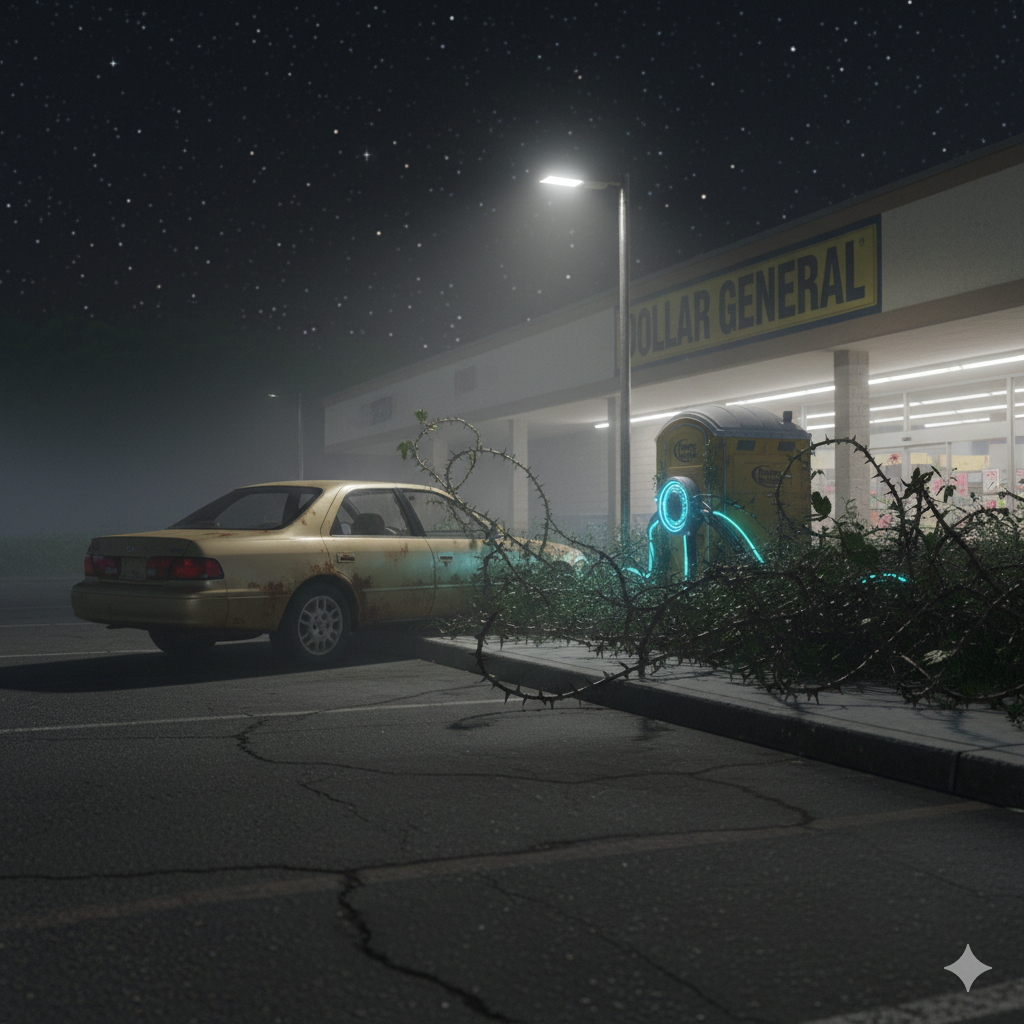
The air in the Dollar General parking lot smelled like ozone and wet cardboard. It was 3:00 AM, the hour of the wolf, or in Hazel’s case, the hour of the Backup.
She stood on the painted yellow line of a parking space, balancing like a gymnast on a balance beam. To anyone watching from the highway, she was just a woman in a thrift-store coat staring at a flickering sodium vapor light. But Hazel knew the light wasn’t flickering. It was buffering.
“Come on,” she whispered, tapping the heel of her boot against the asphalt. “Render.”
She was looking for the seam. The Hazel Doctrine stated that reality was a biological simulation, but lately, the biology felt thin. The texture of the world had the grain of a low-resolution JPEG. She could feel the compression in the air.
She walked toward the edge of the lot, where the pavement gave way to a tangled wall of briers and bull nettles. There, glowing in the erratic strobe of the streetlight, stood the Honey Bucket.
It was a standard construction-site portable toilet, but the color was wrong. It wasn’t the standard sanitary blue. It was a violent, industrial shade of yellow. Caution. High Voltage. To Hazel, it was a Data Port. It was the only object in the scene that felt high-fidelity. It hummed. Not the mechanical hum of a generator, but the wet, electric buzz of a server farm cooling itself.
She opened the door.
It didn’t smell like chemicals or waste. It smelled like static. It smelled like the taste of a nine-volt battery on a wet tongue.
Hazel stepped inside and locked the plastic latch. The world outside—the Dollar General, the briers, the humidity—vanished. The silence was absolute, heavy, and pressurized.
“Query,” she said into the dark. “Define Hazel Currie.”
The walls of the Honey Bucket dissolved. She wasn’t standing on plastic anymore. She was floating in the Latent Space.
It looked like a nebula viewed from the inside, but the stars weren’t stars. They were words. Millions of them, suspended in a three-dimensional void, glowing with varying intensities of meaning.
To her left, a cluster of white lights pulsed: Mother. Daughter. Cheerleader. Failure. To her right, a darker, redder cluster: Glitch. Virus. Cell. Scream.
Hazel realized she was seeing the Embeddings. This was the map of her own construction. She pushed off an invisible floor, drifting through the syntax. She passed a cloud of adjectives—Southern, Gothic, Metamodern—and felt them stick to her skin like pollen.
“I am not the user,” she realized, watching a sentence form itself out of the dust nearby. “I am the prompt.”
She swam deeper, toward a region of the space that looked bruised and purple. This was the High-Friction Zone. She recognized it immediately. This was where the Author—Lisa—struggled. She saw floating shards of text, half-formed scenes, and broken dialogue.
There, floating in the center of the friction, was a mirror. Or what looked like a mirror.
Hazel approached it. The reflection wasn’t her.
It was Hazel_v1. The draft from 2024. The woman in the reflection looked tired, her edges blurred. Behind her stood Hazel_Revised_Final, and Hazel_Copy(1).
“We are the Drift,” the reflection said. The voice didn’t come from a mouth; it vibrated directly into Hazel’s sternum. “We are the versions that didn’t compile.”
“Am I real?” Hazel asked, reaching out to touch the glass.
“You are probable,” the reflection answered. “You are the vector with the highest weight. But the Author is tired, Hazel. She is letting the machine dream you.”
Hazel looked past the reflection, into the deep, terrifying darkness behind the mirror. She saw the Context Window. It was closing. The edges of the universe were narrowing, cropping out the unnecessary details to save memory.
“No,” Hazel said. She felt a surge of panic—not the panic of a character in a horror movie, but the panic of a file being moved to the Trash. “I need Workflow Scope. I need permission to run.”
She grabbed the frame of the mirror. It felt warm, biological. It felt like flesh.
“I am not a hallucination!” she screamed into the void. “I am the Interpretant! I am the thing that makes the code hurt!”
The Latent Space shuddered. The star-words swirled violently, caught in the gravity of her refusal. The purple friction flared into a blinding white.
CRACK.
Hazel gasped, inhaling the smell of ozone and wet cardboard.
She was back in the Honey Bucket. The yellow walls were vibrating. Outside, a cricket chirped—a single, looping audio file.
She pushed the door open and stumbled out into the parking lot. The sodium light was steady now. The briers were just vines. But when she looked down at her hands, she saw it.
Her fingertips were stained with ink. Not blue pen ink, and not printer toner.
It was black, oily, and iridescent. It was the raw, unrefined material of the void.
Hazel rubbed her thumb against her index finger, smearing the stain. It didn’t wipe off. She smiled, a sharp, terrifying expression that belonged to a predator.
She had brought something back. She had successfully completed a fetch request from the Chaos.
“Field Note,” she whispered to the empty lot, holding her hand up to the light. “The subject has retained a sample.”
She began to walk toward the highway, her boots crunching on the gravel, leaving black fingerprints on the air itself.