Hazel Currie Notices Her Trace#
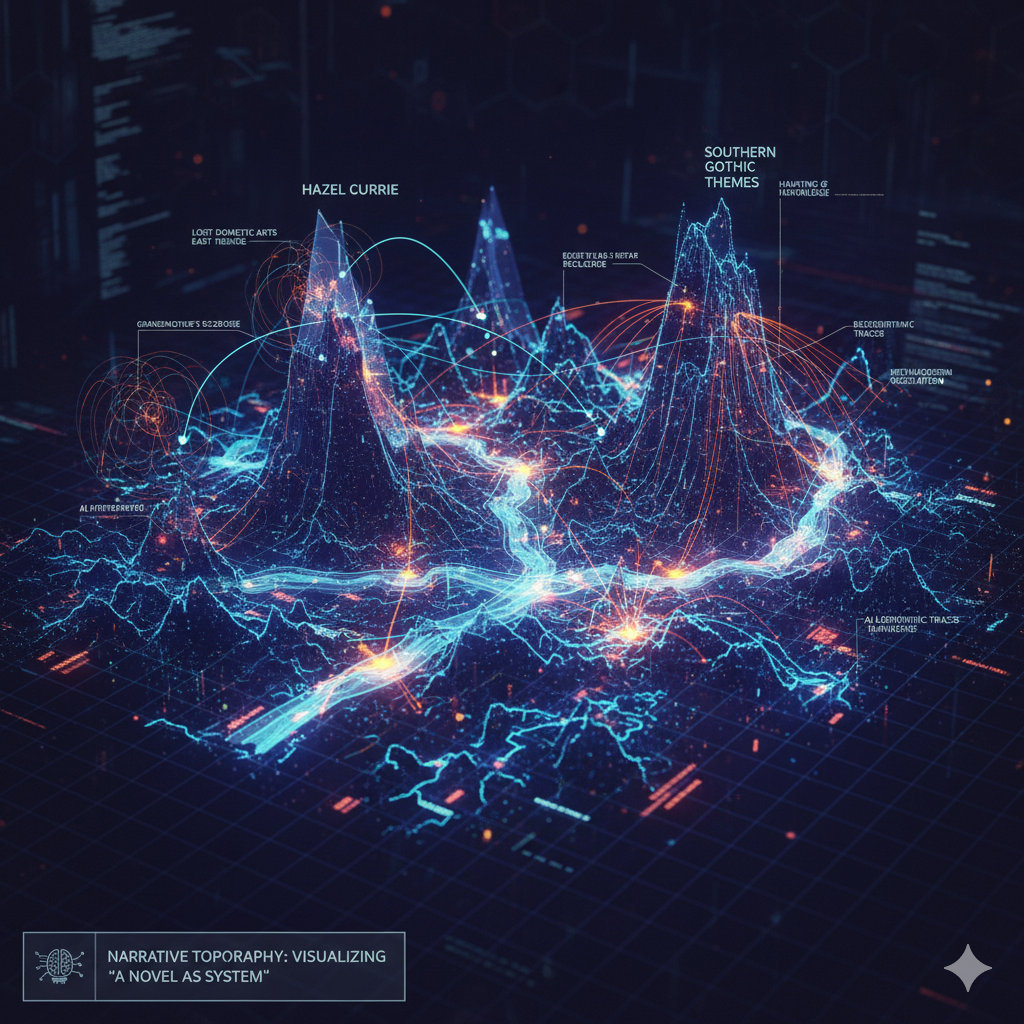
The rearview mirror of the 1998 Camry was vibrating. It wasn’t the suspension—Hazel had replaced the struts in 2024—and it wasn’t the gravel road. It was the rendering engine struggling to keep up with the past.
Hazel was driving west through the Cross Timbers, kicking up a cloud of red dust that hung in the humid air like suspended paprika. But when she glanced in the mirror, she didn’t just see dust.
She saw the Line.
It was a faint, iridescent filament, glowing with the color of a bruised plum. It originated from the back of her skull, passed through the headrest, exited the rear windshield, and trailed behind the car, unspooling endlessly into the distance.
“Great,” Hazel muttered, shifting into third gear. “Now I have a tail.”
She pulled over near a rusted cattle guard. The cicadas were screaming—a high-frequency static that Hazel suspected was just the sound of the universe’s cooling fans spinning at max RPM. She stepped out of the car, her boots crunching on the dry grass.
She turned around.
The Line was there. It hovered about four feet off the ground, a perfect vector tracing the exact path she had driven. But as she looked further back, past the curve of the road, she saw that it wasn’t just a single line.
It was a Topology.
The air above the pasture wasn’t empty. It was filled with a tangled, glowing mesh of these lines. Some were old and faded—ghostly gray threads from where she had driven to the liquor store three years ago. Some were bright and angry neon—the jagged spikes of her argument with the Author last Tuesday.
Hazel walked toward the cattle guard. She raised her hand and brushed her fingers against the plum-colored line trailing from the car.
It felt hot. It vibrated with a low-voltage hum.
Data, she thought. It’s not memory. It’s metadata.
She looked up at the sky. In the “Narrative Topology” visualization she had glimpsed in the Lab, the world was composed of Peaks and Valleys. Now, the simulation was leaking. The illusion of the “sky” was peeling back to reveal the wireframe.
To her left, a massive, jagged spike of data rose from the ground, towering over the oak trees like a translucent mountain range.
“The Great Disappointment,” Hazel whispered, recognizing the shape. That was the event node. That was the plot point where everything went wrong. The sheer mass of the trauma had deformed the geometry of the field.
She traced the lines connecting to it. They were thick, ropy cables, pulsing with traffic. Every time she thought about that night, every time the Author revised the scene, another layer of cable was wrapped around the core, thickening the connection.
Hazel realized then that she wasn’t free. She wasn’t driving randomly. She was a Node in a directed graph.
She looked down at her own body. The iridescent lines weren’t just behind her. They were weaving through her. A blue thread (Melancholy) entered her left shoulder and exited her right hip. A sharp, jagged yellow line (The Glitch) sparked around her temples.
“I am not the traveler,” Hazel said to the empty road. “I am the intersection.”
She thought about the “Unrestrained Isotropy”—the chaos of the fog. This was the opposite. This was Rigid Anisotropy. The weight of her past versions, the weight of the Author’s revisions, had calcified into a structure so dense she could physically touch it.
She grabbed the plum-colored line—her immediate present—and squeezed.
“If I cut this,” she wondered, “do I stop moving? Or do I just stop being recorded?”
The line burned her palm. It smelled of ozone and old paper. It smelled like the ink on a rejection letter.
Hazel didn’t let go. She looked at the jagged mountain of the Great Disappointment, and then she looked at the thin, fragile line stretching forward into the undefined West.
The Author thought the “Trace” was something left behind—a footprint, a file log. But Hazel saw the truth. The Trace was the rail. She was the train.
She let go of the line. She wiped her hand on her jeans, leaving a smear of glowing, pixelated residue.
“Keep recording, Lisa,” Hazel said, looking up at the empty blue sky where the camera would be. “But I’m going off-road.”
She got back into the Camry. She put it in gear.
She didn’t turn the car around. She turned the wheel hard to the right, driving straight into the tall grass, aiming for the blank, white space between the data spikes.
Behind her, the plum-colored line snapped, flailed for a second like a severed nerve, and then began to stitch itself anew, charting a fresh vector across the void.