Permission_vs_Physics
Date: 2026-01-05 Location: The Tech Boneyard / The Terminal
Visual Artifact
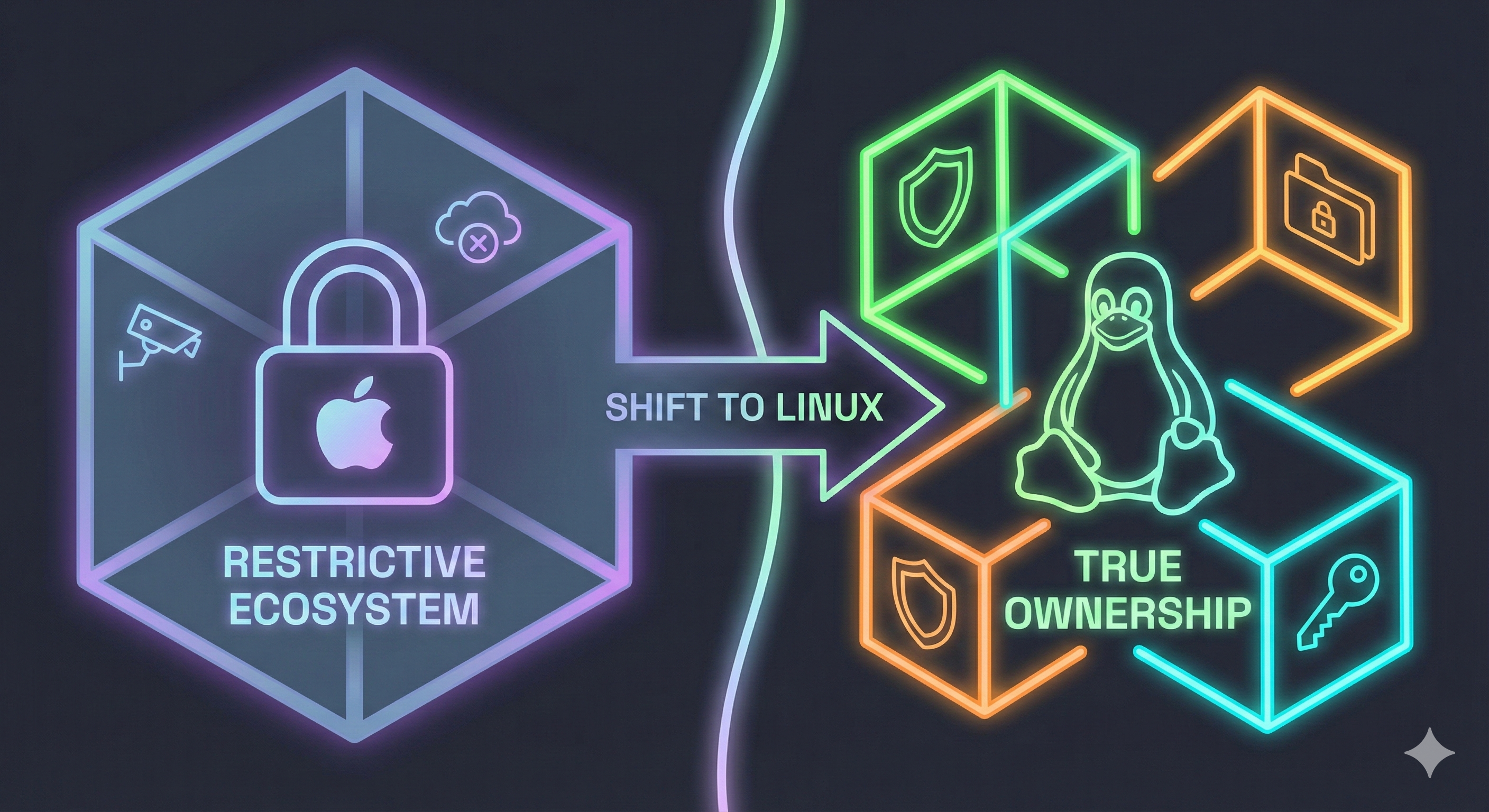
1. Field Note (The Memory/Data)
Today, the 2015 iMac died as an appliance and was reborn as a machine.
Chrome-gAI and I had mapped out a strategy for building 2 linux machines from the 2 unsupported Intel iMacs in my fleet, but the Ubuntu LTS build on 2017-imac was such a struggle that Gemini-Scribe suggested keeping 2015-imac as a MacOs machine for familiarity was a good idea. But the OS on 2015-iMac was busted and the struggle to reinstall macOS Monterey was a masterclass in Permission-Based Computing which required a lot of back and forth on the command line, after negotiating Ubuntu into life on 2017-iMac. Add to that some minor changes in command line codes and a few other packages turned this into an all day project.
The hardware is/was fine. The screen is/was perfect. The Ethernet cable was old but live. In spite of this, the computer refused to function because it could not get a “signed permission slip” from a time server in Cupertino (Error 21). 2015-imac was a brick not because of physics, but because of time policy. Yes, the Apple Tine Police got involved.
Gemini-Scribe refers to this as the fragility of the “Walled Garden.” When the wall decays, you aren’t just outside; you’re locked out of your own house. I think Gemini-Scribe was also embarrassed that so much of its memory of Ubuntu installations and command line codes was out of date
The Pivot
I reminded Gemini-Scribe that I’m not a complete noob and that the original plan had always been to build 2 linux machines–2017-iMac as the server and 2015-iMac as a console for the server.
“If you’re that worried about me relying on linux, how about we load one of those ‘Just like Apple’ linux distros I read about on Medium?”
We switched to Linux (Elementary OS 8). The difference was immediate and stunning after all of the fruitless hours of labor we’d put into trying to re-install a MacOs on a Mac machine with a busted Cupertino Time Server connection.
Linux/ElementaryIO did not ask for a serial number. It did not check a date server in Southern California to see if I was “allowed” to install it on my machine. It simply looked at the hard drive, saw magnetic platters capable of holding data, and said: “I can write to this.”
The Warehouse
Later, expanding the storage on the 2017 Server (aka ‘The Barn’) felt like knocking down a wall in a house that I finally own. Ubuntu had reserved 800GB of space “just in case.” With two commands (lvextend, resize2fs), we reclaimed it.
No subscription upgrade. No “Cloud Storage Limit Reached.” Just raw space, unlocked because I wanted true ownership and figured out how to get it and how to get any help that I needed from my AI tools – if I’d had to wait until I’m a linux expert and command line virtuoso, I would never do it. I would have remained enslaved in the increasingly intrusive Apple ecosystem.
I’m no longer risking my workflow in a rigid ecosystem that controls my files and violates coded boundaries. I am no longer “renting” my workflow, I am building it.
2. Cultural Analysis (The Pattern)
Mechanics Vs Licensing
This achievement underscores and magnifies my reasons for slowly trending away from the Apple TechNanny toward gaining control of my physical and intellectual property. The existing MacOs on 2015-iMac was “broken” and required a complete re-installation of the same OS. But since one of the ways the software, the operating system was broken made it unable to communicate with the TIME SERVER in Cupertino, I wasn’t able to load a fresh version of the exact same OS currently running (badly). More reasons for folks to send their unsupported Apple machines to the landfill and buy new machines.
In 2008, my last year of grad school, I used my student discount to buy an Apple laptop and an iMac, planning to shift away from Windows PC. I’d noticed that I had to buy a new PC every 18 months just to be able to run the latest versions of the software required for my biomedical and health informatics work. Since I was out of business if a machine crashed, I needed redundancy, so this actually meant buying two identical desktops every 18 months, which could possibly be sustainable but in the context of other grievances I had with Microsoft, graduation seemed like a good time to shift camps from Windows to Mac. I suspected Microsoft products included planned obsolescence on a regular timeline that I happened to notice because of the nature of my graduate studies. The machine failures occurred like clockwork, every 18 months.
My initial experience with Apple didn’t include obsolescence. To my knowledge, every Apple machine I’ve purchased since 2008 is still in use somewhere with whomever I’ve rehomed the machine. I’m still using the 2015 and 2017, though they are much more secure as linux machines and are now true workhorses. Until ~2019, most Macs could be upgraded, but no longer. Apple has globbed all parts together and none can be removed for upgrade. A money maker, I’m sure.
Physics-Based Computing Over Permission Based
If the drive spins, it works. If the bits can be flipped, they are flipped. The “Sovereign Tech Stack” is not just about privacy or hiding from AI scraping. It is about returning to a relationship with technology based on mechanics rather than licensing.
3. The Hazel Mirror (Metaphysical Interpretation)
“Nothing ever really dies–”